Will the Grand Canyon Flood Again
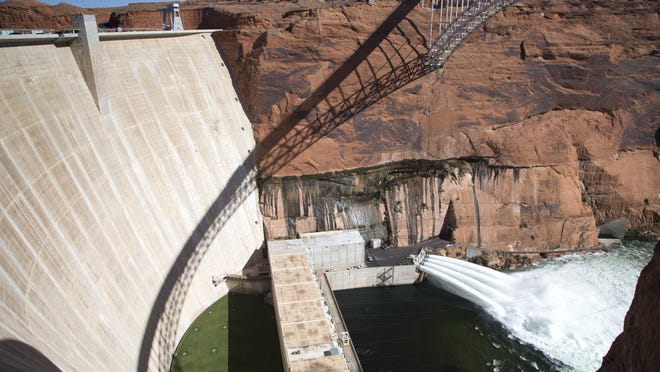
The Southwest's active monsoon season this year done tons of sand into the Colorado River, where it could accept helped shore upwards the Grand Canyon's withering beaches, if non for 1 big trouble: The water stored behind Glen Canyon Dam is at an all-time low after more than two decades of drought.
As a issue, the federal government's dam managers accept hit break on an environmental plan that calls for controlled floods out of Lake Powell when in that location's enough sand for the water to push upwards and rebuild sandbars and beaches, preserving the national park's ecology, river trip campsites and archaeological sites.
Prodigious rains from the summertime and fall monsoon dumped the sand that created the right atmospheric condition for a November flood but left nowhere most enough water to prop upward the shrinking reservoir.
The U.S. Agency of Reclamation cited projected losses in the dam's hydropower production as a reason to hold dorsum the envisioned floodwaters. That could relieve up to $4 meg for electric ratepayers across the West, but information technology as well sets an ominous precedent for a river that's becoming also tuckered by aridification and overuse to sustain its own health.
"The beaches are hammered downward there," Grand Coulee river guide Ben Reeder said after working a season in which monsoon storms slashed gullies through campsites and rolled boulders onto them.
Reeder represents recreational interests on a technical piece of work grouping advising the regime within its Glen Canyon Dam Adaptive Management Plan only did not have a vote on whether to inundation the canyon. Though an official reason for rejecting a flood was the cost, Reeder said he had also heard from officials that the "optics" of sending water downstream in a year of shortage would be bad.
"The science is saying we take the atmospheric condition to practice a (loftier) flow," he said, "and we should exercise a catamenia."
For now, more than a million metric tons of sand volition stay parked on the riverbed at Lees Ferry, where some of it will creep downstream.
Unnatural wonder:A journey into the heart of a river forever changed by homo hands
Floods aid restore a semblance of nature

The dam that created Lake Powell in the early 1960s choked off more than than nine-tenths of the Colorado's contribution to M Canyon'south sand flow, dropping it on the new lakebed and sending articulate water downstream from the hydropower plant's turbines.
That left the sand that the Paria River washes out of southern Utah toward the Colorado at Lees Ferry to build beaches in the upper Grand Coulee, and the sand from Arizona's Little Colorado River deeper in the canyon.
Starting in the 1980s, a group of scientists puzzling over how to restore a semblance of nature in the canyon imagined a program opening the dam'due south bypass tubes to create artificial floods whenever enough sand accumulated for the pulse of water to button it downstream and deposit information technology on bars and beaches.
Benefits would include everything from the creation of shallow, warm backwaters more familiar to the river'southward native fishes to coverage of threatened artifacts, and restoration of beaches for float trips that account for more than 100,000 user days on the river each yr.

The occasional planned floods began in 1996, four years after Congress passed the Grand Coulee Protection Act mandating dam operations that residue water and power needs with the canyon'south environment. The floods continued haltingly, every several years until the Obama administration adopted a plan that supporters believed took costs and politics out of the equation and would trigger a flood whenever sand measurements at Lees Ferry warranted one.
That would include this fall when Utah Land University river researcher Jack Schmidt said the sand is more than plentiful than it is in three out of every 4 years.
Schmidt was among the scientists who first envisioned the controlled floods, and he later directed the U.S. Geological Survey's Grand Coulee Monitoring and Inquiry Center. He said he fears the government's decision against flooding when there's this much sand indicates that depression water levels are leading to backsliding on the commitment to manage according to the science.
"This decision takes us dangerously shut to the one-time globe where politics dictates non having a flood," Schmidt said.
Bureau cites cost to power customers
Reclamation officials at the bureau's Upper Colorado Bowl part in Common salt Lake City decided against conducting a overflowing this fall. They did not reply to a asking for comment, merely a agency presentation at the technical piece of work group's fall meeting cited the Western Area Power Assistants'southward hydropower cost estimates as a reason that regional state and federal officials brash against pushing more water downstream.
They determined that a 60-hour flood of the sort that has occurred before would cost $ane.3 million in lost hydropower revenues, while an unprecedented 192-hour flood — immune by rule when sand accumulates like it did this twelvemonth — would price $3.7 million.
A 192-hr flood could accept been particularly problematic, the officials reported, because it would have dropped the lake'south meridian by 5 anxiety, to within about 10 feet of the dam's buffer zone for producing hydropower without damaging the turbines. A sixty-hour flood would limit the reduction to nearly ii feet.
Some river advocates responded that it shouldn't matter because all that water would end upwards downstream behind Hoover Dam, where it'due south ultimately headed anyway before fulfilling downstream farm and city uses. Others complained that if dam managers didn't like those outcomes they could have projected what would happen during a shorter flood of perhaps thirty hours.
"Information technology's definitely a large loss for M Canyon," Alicyn Gitlin, the Sierra Club's Thousand Coulee program manager, told The Arizona Commonwealth. "It'due south also confirmation that, with climate change, nosotros may non exist able to protect Thousand Coulee with this dam."
Schmidt said the relative costs of lost power production are minimal compared to what the drying river'south trajectory has in store. The hydropower outlook is declining long-term considering of aridification and h2o need, he said. "It has zero to practise with controlled floods."
Law's mandate is 'articulate as mud'
Controlled floods, officially known as high-menses experiments, are no cure for what ails the Grand Canyon. They temporarily restore beaches, which are and then eroded over time by flows that fluctuate to run into water and power demands. Only the next flood can keep them from eroding to critically low levels.
Today, with no overflowing since 2018, the sandbars and beaches are as depression every bit they've been in a decade, and are projected to reject some other 10% before next year'due south rafting flavor. Had the government scheduled a 192-60 minutes overflowing, the beaches were projected to grow by 75%, and to remain 50% larger after winter erosion.
Representatives from several organizations and tribes that participate in the plan's technical piece of work grouping complained of the decision and their exclusion from the contend. "We were not consulted," Hopi tribal archeologist Jakob Maase said. "Consultation needs to happen."
"It seems equally though the Grand Canyon Protection Act was not given much weight," said Peter Bungart, a cultural resources officer for the Hualapai Tribe.
That law's mandate for managing the dam in harmony with canyon resources is "clear every bit mud," according to Academy of Utah law professor Robert Adler. It beginning directs the government to release water in a way that protects and restores the natural and recreational resources for which Grand Canyon National Park and Glen Canyon National Recreation Area were established.
Then it says to do that in a fashion that's consistent with the suite of other laws governing the river's water storage and distribution agreements, laws often in conflict with the coulee's environmental interests.
"The G Coulee Protection Human action is a dandy practice in circular logic," Adler said.
The director of a nonprofit that represents consumer-endemic utilities that use Glen Canyon's hydropower also noted the law'southward offsetting demands, and a federal guess's ruling in a pertinent example saying the M Coulee Protection Deed doesn't trump other resources such equally power.
"Reclamation has a balancing act to perform," said Leslie James of the Colorado River Energy Distributors Association. "The Grand Coulee Protection Deed is not a standalone mandate."
Nevertheless, environmental groups and tribes objecting to the inundation's rejection and the exclusive decision-making process sent a joint letter to the Bureau of Reclamation on Wed seeking a greater function in future flood debates, and greater consideration to the Grand Canyon Protection Act.
"Ultimately, we are concerned that the precedent set by the decision to forego (a fall flood) is based primarily on considerations put forth by ability generation and water interests," they wrote.
"In that location's no consideration," said Larry Stevens the One thousand Canyon Wildlands Council, one of the letter'southward authors. "They just kind of abolish the high-flow event simply don't provide whatsoever options."
If losing a few million dollars in revenues is to get a flood disqualifier, Stevens said, at that place may never be more than floods.
"Using the alibi that information technology's going to cost too much money is not the fashion we desire to manage the river," he said. "At that place's ever going to exist a cost."
James, of the energy distributors association, said she does not believe toll alone volition e'er rule out experiments such as a controlled inundation. This yr, she said, the authorities too had to consider the furnishings of dropping the reservoir level and then soon after taking emergency action to prop it upwardly by releasing water from dams upstream on the upper Green and Colorado rivers.
Those releases were meant to protect water levels in case the coming winter is as dry as the last, she said, and they could be negated by a flood correct now.
With a fall flood ruled out, Stevens and others promise Reclamation may consider flooding the canyon later, ideally subsequently an increasingly rare snowy winter helps restore h2o levels. Spring floods were the natural way of the river before dams when the snowfall melted and generated much college flows than are possible today.
The National Park Service, as one among agencies advising Reclamation's dam operations, is discussing the merits of a spring overflowing.
"We are interested in continued dialog about whatsoever spring possibilities to address this, and to protect the resources under the Grand Coulee Protection Act," the agency'south Colorado River coordinator told Stevens and other members of the technical work group.
Such a plan could face a bureaucratic snag, though. Under the rules enabling controlled floods, the bookkeeping twelvemonth for the sand required to trigger one resets on Dec. i. That means that even though heaps of this year's monsoon sands may remain simply downstream of the dam next bound, they won't officially count toward justifying a flood and so.
Brandon Loomis covers ecology and climate problems for The Arizona Democracy and azcentral.com. Accomplish him at brandon.loomis@arizonarepublic.com.
Environmental coverage on azcentral.com and in The Arizona Republic is supported past a grant from the Nina Bricklayer Pulliam Charitable Trust. Follow The Democracy environmental reporting team at environment.azcentral.com and @azcenvironment on Facebook, Twitter and Instagram.
Source: https://www.azcentral.com/story/news/local/arizona-environment/2021/11/01/feds-say-theres-too-little-water-spare-grand-canyons-beaches/6201263001/
0 Response to "Will the Grand Canyon Flood Again"
Postar um comentário